



-
 Written By:
Kristina Daniels
-
Edited By:
Phyllis Rodriguez, PMHNP-BC
-
Clinically Reviewed By:
Dr. Ash Bhatt, MD, MRO
 Written By:
 Edited By:
 Clinically Reviewed By:
Individual therapy for addiction is a series of private, one-on-one sessions with a licensed clinician, where you talk through your substance use, what triggers it, and what is going on underneath it.
Therapy is just one part of addiction treatment, since some people also need medical care, withdrawal support, medication, or a more structured program. This guide will help you work out whether therapy on its own is enough for you or whether you need more support alongside it.
Along the way, we cover what happens in a session, how individual therapy compares with group therapy, which approaches clinicians use, how long therapy lasts, and how insurance fits in.
If you would rather talk to a person than read, the admissions team at Legacy Healing Center Ohio can walk you through your options.
What Is Individual Therapy for Addiction?
Individual therapy, which some providers call individual counseling, is one-on-one time with a trained clinician such as a licensed counselor, social worker, psychologist, or psychotherapist. Because nobody else is in the room, many people find it easier to talk about things they would never bring up in front of a group.
That privacy is protected by law. Federal rules, including HIPAA and 42 CFR Part 2 (which covers substance use treatment records), limit who can see what you share. There are legal and safety exceptions, so your therapist may have to share information if you are at serious risk of harming yourself or someone else, if a child or vulnerable adult is being abused, or if a court orders it. A good clinician explains these limits at the start, so you know exactly where the line sits.
The work itself is built around you. Your therapist starts by learning your history with alcohol or drugs, what an ordinary day looks like, and what you want recovery to look like, and your goals grow out of that conversation. As your life changes, the goals change with it.
Over time, you and your therapist look at the triggers, cravings, stress, and feelings that tend to show up before you use, and you practice a response to each one so it feels familiar by the time you need it.
Therapy is different from medical treatment and from peer support. A clinician helps you change patterns of thinking and behavior, while medication and withdrawal management come from medical providers, and mutual-help meetings such as AA or NA are led by peers. Many people use a mix of all three.
Individual Therapy vs. Group Therapy for Addiction
Most people who search for this comparison want to know which one to pick, and the honest answer is that it often isn’t an either-or choice.
In an individual session, you get a clinician’s full attention and room to go deep into your own history. In group therapy, a clinician leads several people through shared topics such as coping skills, communication, and relapse prevention. Hearing how other people handle the same problems can make your own feel less isolating, and a group also gives you a place to practice speaking up.
Group therapy is clinician-led treatment, which separates it from a peer-led recovery meeting. A peer meeting can be a real source of support, but it does not follow a clinical treatment plan.
| Factor | Individual Therapy | Group Therapy |
| Format | One client and a therapist | Several participants and a facilitator |
| Main focus | Your personal needs and goals | Shared learning, interaction, and recovery skills |
| Feedback | Tailored to your circumstances | Perspectives from the facilitator and peers |
| Privacy | Confidentiality rules apply, with legal and safety exceptions | Members are expected to keep confidences, but no one can guarantee what others do |
| Common topics | Triggers, personal history, mental health, coping strategies | Coping skills, communication, shared challenges, relapse prevention |
| Best use | Individualized exploration and treatment | Practicing skills and learning from others |
| Can they be combined? | Yes | Yes |
Neither format is better for everyone, because what fits depends on your clinical needs, your comfort level, and the rest of your treatment plan. That is why many programs include both, and why your assessment tells you more than any general rule.
Not sure which format fits you?
Call Legacy Healing Center Ohio and talk with our admissions team about the treatment formats.
What Happens During an Individual Therapy Session?
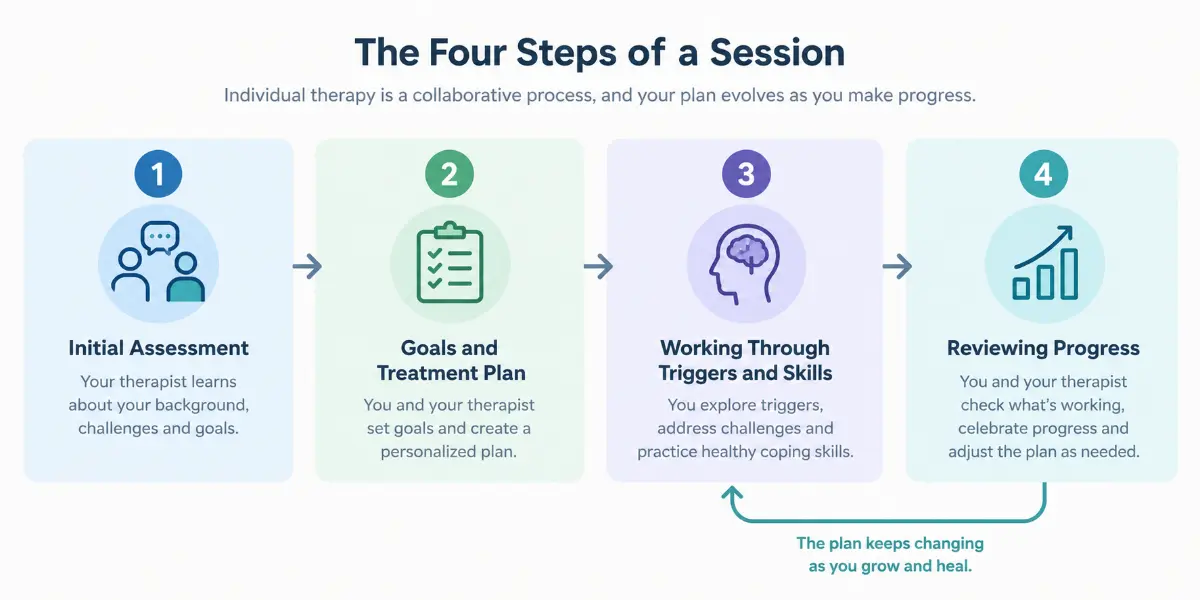
Every therapist works a little differently, but individual therapy for addiction tends to follow a pattern, and knowing that pattern ahead of time takes some of the fear out of the first appointment. Here is how the process usually unfolds, from your first conversation to the point where you look back at how far you have come.
Step 1: The Initial Assessment
The first appointment is usually an assessment, and it feels more like a conversation than a test. Your clinician asks about your substance use history, any past treatment, your physical and mental health, your family and work situation, and what finally made you reach out.
Some of these questions are personal, so you can go at your own pace, and if a topic feels too heavy, you can say so and come back to it later. The assessment also helps your clinician spot needs that therapy alone cannot meet, such as medical withdrawal support or a mental health condition that needs its own treatment.
Step 2: Setting Goals and Building a Treatment Plan
Once your therapist understands your situation, the two of you set goals together. A goal might be stopping completely, cutting down, understanding what led to a relapse, or getting through a hard stretch at work or home without using, and it can be as specific as making it through the holidays.
Your therapist then writes these goals into a treatment plan that also covers how often you will meet and which approaches you will use. It helps to treat that plan as a first draft, since it gets revised as you learn what works for you.
Step 3: Working Through Triggers and Building Coping Skills
This is where most of your sessions happen. You usually start by checking in on how the week went, including any cravings or slips, and then pick one situation to work on, such as an argument with a partner, a stressful shift, or an evening routine that always ended with a drink.
Your therapist helps you understand what was going on in that moment, and then you practice a different response, for example by rehearsing what you would say when someone offers you a drink or by writing out what you will do when a craving hits at 10 p.m. Many therapists also suggest small tasks between sessions, like tracking your triggers in a notebook, so the skills carry over into daily life.
Step 4: Reviewing Progress and Adjusting the Plan
Every so often, your therapist sets aside time to look back at your goals and ask what has changed. If something is working, you keep building on it, and if something is not, the plan changes, which might mean trying a different approach, meeting more often, or adding group therapy or medical support.
Good therapists also stay in touch with the rest of your care team, so what you work on in session fits with your medication, your doctor, and any program you attend.
Types of Therapy Used for Addiction
Clinicians draw on several approaches, and a good treatment plan often combines more than one. The National Institute on Drug Abuse (NIDA) describes behavioral therapies as a core part of addiction treatment, often used alongside medication. These approaches are not interchangeable and not every program offers all of them, so it helps to ask your provider which ones are available.
Cognitive Behavioral Therapy (CBT)
CBT teaches you to notice the thought that comes right before the urge. If your usual thought is “I had a terrible day, I deserve a drink,” you learn to catch it and try a different response. Sessions often include homework, such as tracking your triggers during the week, so you can see the pattern for yourself.
Motivational Interviewing
Many people feel two ways about quitting at the same time, wanting a different life while still leaning on the substance to cope. In motivational interviewing, your therapist asks questions that help you put your own reasons for change into words, and your reasons are usually easier to act on than anyone else’s.
Contingency Management
Contingency management rewards specific behaviors that you and your care team agree on in advance. For example, you might earn a small incentive for attending every session in a month or for a negative drug screen.
The early weeks of recovery often feel like all effort and no payoff, so this structure gives you something concrete to work toward while other coping skills are still developing. It is used where clinically appropriate and is not available at every program, so ask whether yours offers it.
Relapse-Prevention Therapy
Relapse-prevention therapy starts by mapping your personal high-risk situations, which could be certain people, places, times of day, or moods such as loneliness or boredom. For each one, you and your therapist write a specific plan, such as who you will call, where you will go instead, and what you will say to yourself.
The plan also covers what happens after a slip, because a slip does not mean treatment has failed, and having a next step ready makes it easier to get back on track quickly instead of spiraling into shame. You update the plan as new risks appear, such as a job change or a move.
Trauma-Informed and Trauma-Focused Care
These two terms mean different things. Trauma-informed care means your clinician delivers treatment with an understanding of how trauma affects people, for example by moving at a pace that feels safe to you. Trauma-focused therapy directly targets trauma-related symptoms, and it is used when it is clinically appropriate and you are ready for it.
Family Therapy
Addiction affects the people around you, and family sessions give you a place to work on communication and boundaries with them. Family therapy adds to individual therapy and does not replace it.
Therapy for Depression, Anxiety, and Co-Occurring Disorders
Many people in addiction treatment also live with depression, anxiety, or the effects of trauma. Sometimes the mental health condition came first and substance use became a way to cope, and sometimes substance use made the symptoms worse. It is often hard to tell which came first, and you do not have to settle that question before you start.
When a mental health condition and a substance use disorder are present together, they are called co-occurring disorders. Individual therapy can address both:
- Depression counseling looks at low mood, loss of interest, hopelessness, and sleep problems, and builds routines that make it easier to get through the day.
- Anxiety-focused therapy teaches you to recognize the physical and mental signs of anxiety and to respond without reaching for a substance.
- CBT helps you spot thought and behavior patterns that feed both the mental health symptoms and the substance use.
- Trauma-focused approaches are used when trauma is part of the picture and you are stable enough to work on it safely.
Care should account for both conditions at the same time. If anxiety is what drives the drinking, treating only the drinking leaves the anxiety in place, and the pull to drink often returns with it. The same is true in the other direction, so telling your therapist about both from the start helps them plan treatment that fits.
How Long Does Individual Therapy for Addiction Last?
People usually ask this because they want to plan their lives around treatment, and the most helpful answer starts by splitting the question into three smaller ones: how long each session lasts, how often you meet, and how long you stay in therapy overall.
Session Length
A session commonly runs about 45 to 60 minutes. Your first appointment may run longer because of the assessment, and the exact length depends on the clinician and the level of care you are in.
How Often You Will Meet
Many people meet with their therapist once a week, which leaves time to practice between sessions while keeping momentum going. In the early stages, when cravings and stress tend to be strongest, some people meet twice a week or more, and people in intensive outpatient or partial hospitalization programs may have therapy built into several days of their week. As things steady out, sessions often space out to every other week or occasional check-ins.
How Long You Will Stay in Therapy
There is no standard answer here, and a clinician who gives you an exact end date before getting to know you is guessing. Several things shape the timeline:
- The substance involved and how long you have been using it.
- Whether you are also living with depression, anxiety, trauma, or another condition.
- How much support you have at home and at work.
- How much stress you are carrying right now.
- How you respond to the approaches your therapist uses.
Some people work with a therapist for a few months, others stay for a year or longer, and some return for check-ins when life gets harder.
It also helps to separate ongoing individual therapy from the length of a treatment program. If you are in residential, intensive outpatient, or outpatient care, therapy happens inside that program and the program has its own timeline, which your team sets after your assessment. Many people keep seeing an individual therapist after the program ends, because that is when daily life, and the triggers that come with it, return in full.
Because recovery rarely moves in a straight line, your therapist will check in on your progress regularly and adjust the length with you, so the plan stays tied to how you are actually doing.
What Topics Do You Discuss in Individual Therapy?
You have a lot of say in what comes up, and your therapist helps keep the conversation moving toward your goals. If you are wondering what you would actually talk about for 45 minutes, these are the topics that come up most often:
- Triggers come up in almost every session, since understanding what sets off the urge to use, whether that is a person, a place, a feeling, or a time of day, gives you something to plan around.
- Cravings get their own attention, including what they feel like for you, how long they last, and what helps them pass, so they feel less like an emergency when they arrive.
- Relationships often need work, because substance use tends to strain trust with partners, family, and friends, and therapy gives you space to talk about repairing it or setting boundaries.
- Stress from work, money, or family pressure usually sits behind a lot of use, so you and your therapist look for ways to handle it that do not end in a drink or a drug.
- Shame and guilt are common, and talking about them with someone who is not judging you can loosen their hold, which matters because shame often keeps people stuck.
- Emotional regulation covers anger, sadness, panic, and loneliness, and the skills you build here help you stay with a hard feeling long enough to let it pass.
- Trauma comes up when it is relevant and when you feel ready, and your therapist will not push you into it before then.
- Grief and major life changes, such as losing someone, a divorce, or a move, can shake your recovery, so they are worth working through before they pile up.
- Relapse prevention is an ongoing topic, since your plan needs to be revisited as your life changes.
- A daily routine for sleep, meals, movement, and structure sounds ordinary, but it often makes the difference between a recovery that holds and one that wobbles.
You set the pace, and nothing has to come up before you are ready to talk about it.
Does Insurance Cover Individual Therapy for Addiction?
Many health plans cover eligible behavioral health treatment, and federal law generally requires plans that cover mental health and substance use treatment to do so on terms comparable to medical care. Even so, coverage varies from plan to plan, and two people with the same diagnosis can pay very different amounts.
A few insurance terms decide what you pay, and knowing them helps you read your plan:
- Your deductible is the amount you pay before your plan starts covering costs.
- A copayment is a flat fee you pay per visit.
- Coinsurance is a percentage of the cost that you share with your plan after the deductible.
- Network status tells you whether the provider has an agreement with your plan, and out-of-network care often costs more.
- Prior authorization is approval your plan may require before treatment begins.
- Benefit limits cap how many visits or days your plan covers.
Ohio Medicaid lists behavioral health services for eligible members, so it may be a route to coverage if you qualify. Eligibility and covered services depend on your situation, and not every provider or service is covered, so confirm with the provider before you begin.
The most reliable way to find out what your plan covers is to call the number on your insurance card, as SAMHSA suggests. It helps to have your questions written down before you call:
- Does my plan cover individual therapy for substance use?
- Is this provider in my network?
- Do I need prior authorization before my first session?
- What are my deductible, copay, or coinsurance?
- Is there a limit on the number of visits?
- Does my plan also cover other levels of care, in case I need them later?
Write down the date of the call and the name of the person you spoke with, since that makes any later disagreement easier to sort out.
Worrying about cost should not stop you from asking for help. Contact Legacy Healing Center Ohio to ask what your coverage may look like.
Is Individual Therapy Enough, or Do You Need a Treatment Program?
For some people, individual therapy is enough, particularly when substance use is mild to moderate, home life is stable, and there are no medical risks. Others need more structure, and a clinical assessment is how you find out which group you fall into. Depending on what it shows, your clinician may recommend one or more of these:
- Outpatient therapy means you attend appointments and then go home, which works when you have a stable, supportive place to return to.
- Intensive outpatient care adds several sessions a week and more structure, and it suits people who need more support than weekly therapy gives but can still live at home.
- Residential treatment means living at a facility with daily care, and it is often considered when home is not a safe place to recover or when previous attempts at lower levels of care have not held.
- Withdrawal management is medically supervised care while your body clears a substance. Withdrawal from alcohol or benzodiazepines can be dangerous, so please do not try it alone.
- Medication is available for some substance use disorders, including opioid and alcohol use disorders, and it is usually combined with counseling.
Some signs suggest weekly therapy may not be enough on its own: using every day, repeated unsuccessful attempts to cut down, withdrawal symptoms when you stop, a home environment where others are using, or severe depression, anxiety, or trauma symptoms. If you are ever having thoughts of harming yourself, call or text 988 to reach the Suicide & Crisis Lifeline right away.
Therapy is not a substitute for medical care when you need it, and it also works best as part of a plan that fits you. SAMHSA gives an overview of treatment types if you want to read further.
How to Get Started With Individual Therapy
Starting is often the hardest part, and it helps to break it into smaller steps, since you do not need to have everything figured out before you begin. The sections below cover what to ask, what to look for, and how to prepare.
Questions to Ask a Provider
Before you commit to a provider, a handful of direct questions will tell you most of what you need to know:
- What are your clinicians’ licenses and qualifications, and do they have experience with addiction and co-occurring mental health conditions?
- Which therapy approaches do you use for substance use?
- How do you build a treatment plan, and how often do you review it?
- Which insurance plans do you accept, and what do you charge if I pay out of pocket?
- How do you coordinate with my doctor or psychiatrist?
- What is your cancellation policy?
SAMHSA also offers a checklist for finding quality treatment, and you can ask a trusted friend or family member to go through it with you.
What to Look for in a Therapist
Credentials matter, but so does how comfortable you feel. Research and clinical experience both point to the working relationship as something that shapes how therapy goes, so pay attention to whether you feel listened to and whether your therapist explains things in a way that makes sense to you.
It can take a session or two to know. If it still feels wrong after a few visits, you are allowed to ask for a different clinician, and a good provider will not take that personally.