


-
 Written By:
Kristina Daniels
-
Edited By:
Phyllis Rodriguez, PMHNP-BC
-
Clinically Reviewed By:
Dr. Ash Bhatt, MD, MRO
 Written By:
 Edited By:
 Clinically Reviewed By:
Key takeaways
- Trauma raises the risk of alcoholism, but it is not the sole cause. Patients recover fastest when treatment addresses both trauma and drinking at the same time, not one after the other.
- Alcohol gives real, short-term relief from trauma symptoms like anxiety and racing thoughts. This is exactly why it becomes a habit before the person even notices they have a drinking problem.
- Trauma-bond withdrawal and alcohol withdrawal can look similar, since both cause anxiety and a strong urge to reconnect. But they are different conditions, and alcohol withdrawal should get medical attention without delay.
Trauma and alcohol abuse are connected far more often than people assume, and the connection isn’t random. In this article, we’ll walk through exactly how that shift happens, from the first stress response, through childhood trauma and complex trauma symptoms, to what trauma-informed alcohol treatment actually looks like once someone is ready for help.
Can Trauma Lead to Alcohol Abuse?
Trauma does not automatically cause alcoholism. What the research supports is narrower and more useful: It raises vulnerability to alcohol misuse. This is especially true when someone starts drinking specifically to manage trauma symptoms.
There’s a meaningful difference between three things that often get collapsed into one:
- Drinking occasionally after trauma – This is an isolated response to an acute stressor. It does not always turn into a pattern.
- Alcohol misuse – Drinking creates real problems, like missed work or conflict at home. It does not meet full clinical criteria for a disorder.
- Alcohol use disorder (AUD) – This is a diagnosable condition. It involves craving, loss of control, and continued drinking despite consequences.
PTSD and AUD frequently co-occur, and self-medication, drinking specifically to manage trauma symptoms, is one well-documented pathway between them, though not the only one. The National Institute on Alcohol Abuse and Alcoholism (NIAAA) describes AUD risk as an interaction of genetic, environmental, and psychiatric factors, with trauma exposure listed among the elements that increase vulnerability rather than acting as a standalone cause.
How Trauma Can Turn Into Alcohol Abuse
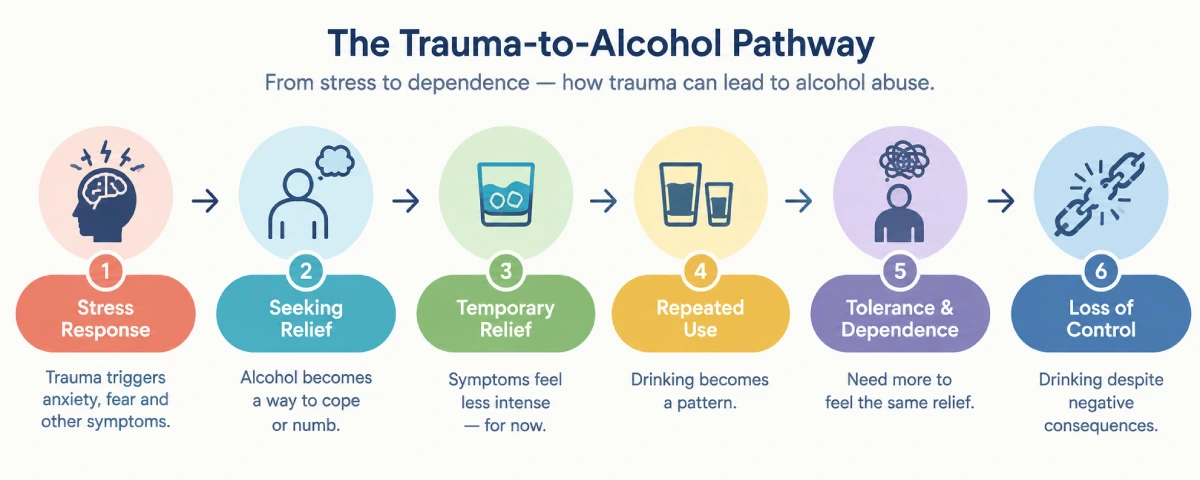
Here’s the progression clinicians actually look for, one stage at a time.
1. Trauma Leaves the Body and Mind in a State of Stress
Trauma can trigger fear, anxiety, hypervigilance, and intrusive memories. It can also cause avoidance, irritability, sleep problems, and emotional numbness. These are symptoms of trauma. They are not automatically PTSD.
PTSD is a specific diagnosis. It requires a clinical assessment. Not everyone who experiences these reactions meets that threshold, and that distinction matters before anyone applies the label to themselves.
The VA’s National Center for PTSD lists upsetting memories, anxiety, jumpiness, and avoidance as common post-trauma reactions. These reactions can last well beyond the event itself. For some people, they persist for months or years without treatment.
2. The Person Starts Looking for a Way to Feel Better
This stage is not a conscious decision. It is an instinct. Living in a constant state of alertness is exhausting, and the brain starts searching for anything that brings it down. The thoughts driving this search sound like:
- “I want my thoughts to stop.”
- “I need to sleep.”
- “I don’t want to feel anything right now.”
- “I feel safer when I’ve had a drink.”
The VA identifies alcohol use as a form of negative coping. People use it to escape problems, fall asleep, or make trauma symptoms recede, even briefly. At this point, alcohol is one option among several the person may try, alongside things like isolation, overworking, or avoidance.
3. Alcohol Provides Temporary Relief
The loop is simple. The person drinks. The distress feels less intense. The brain registers that drinking caused relief. That registration makes drinking more likely the next time distress shows up.
Alcohol is a central nervous system depressant. It slows down racing thoughts. It softens hypervigilance. For a few hours, the person feels calmer than they have in days or weeks. That relief is real, not imagined.
At this stage, the person is usually drinking to manage symptoms. They are not trying to become dependent on alcohol. This distinction matters clinically. It removes unearned shame from a pattern that starts as self-preservation, not recklessness.
Clinical perspective from Dr. Ash Bhatt: I ask patients what alcohol does for them before I ask how much they drink. The answer is almost always specific. It stops racing thoughts. It helps them sleep. It makes a crowded room bearable. That specific answer tells me exactly which trauma symptom needs direct treatment, instead of leaving alcohol to manage it by default.
4. Drinking Becomes a Coping Pattern
The cycle starts to repeat itself. A trigger causes distress. Distress leads to alcohol. Alcohol brings relief. Relief reinforces the pattern. Each round strengthens the link between distress and drinking.
This is not a one-time fix anymore. It becomes the default response to anxiety, insomnia, anniversaries of the trauma, or specific triggers. A person may start drinking before social events to manage anxiety they did not have before the trauma. Another may drink at night specifically to avoid nightmares.
In fact, people with trauma histories are more vulnerable to developing AUD. Stress is also a documented cause of relapse during recovery. That means this loop does not fully disappear once someone stops drinking. It can resurface under pressure.
5. Tolerance, Dependence, and Loss of Control Can Develop
This is where coping starts to look like a clinical problem. Clinicians do not rely on a loose idea of “alcoholism.” They look for specific AUD criteria:
- Tolerance. Needing more alcohol for the same effect.
- Loss of control. Drinking more, or longer, than planned.
- Craving. A strong urge to drink that is hard to override.
- Continued use despite consequences. Drinking even as it damages relationships, work, or health.
- Withdrawal. Physical symptoms when alcohol use stops or drops, once dependence has developed.
A person does not need to meet every one of these criteria to have a problem. Meeting several of them is generally what separates ordinary alcohol misuse from a diagnosable AUD.
6. Alcohol Starts Making the Trauma Symptoms Harder to Manage
The pathway does not stop at trauma leading to alcohol. It keeps going. Trauma leads to alcohol. Alcohol brings temporary relief. That relief leads to alcohol-related problems. Those problems make the trauma symptoms worse. Worse symptoms drive more drinking.
The VA states that alcohol can make PTSD symptoms worse over time. Alcohol used to help with sleep often makes sleep less restful, not more, because it disrupts the deep sleep stages the brain needs to process memories. NIAAA research describes similar effects on cognitive function and a person’s overall ability to cope with daily stress.
Childhood Trauma and Alcohol Abuse
Childhood trauma gets its own section for a reason. It shapes a nervous system that is still developing. That is a different process from trauma experienced as an adult, and the effects tend to be longer-lasting.
Why Childhood Trauma Can Have Long-Term Effects
Childhood trauma covers several categories. It includes abuse, neglect, household instability, and witnessing violence. It also includes loss and chronic fear. NIAAA states that people with a history of childhood trauma are vulnerable to AUD. Its research on adolescent drinking links early adversity to later binge drinking patterns.
According to the CDC, about three in four high school students report at least one adverse childhood experience. One in five report four or more. Substance use is listed among the outcomes this research has documented, alongside other long-term mental and physical health effects.
Long-Term Effects of Childhood Trauma and Alcohol
This is not one straight line from childhood trauma to adult alcoholism. It is a set of overlapping risks that build on each other. Childhood trauma is linked to persistent stress and emotional difficulty. That difficulty can lead to maladaptive coping. Maladaptive coping increases vulnerability to problematic drinking later on.
Once alcohol enters the picture, it tends to add to problems that already exist. This shows up in several areas of life:
- Relationships. Trust issues from childhood can deepen under the added strain of alcohol use.
- Emotional regulation. Alcohol interferes with the brain’s ability to manage mood, which is already harder for trauma survivors.
- Sleep, work, and physical health. Each of these tends to decline together rather than one at a time.
Can Childhood Trauma Cause Alcoholism?
Childhood trauma can increase vulnerability to alcohol problems. It does not, by itself, guarantee AUD. Several other factors shape the outcome:
- Genetics and family history of alcohol use disorder
- Age of first alcohol use
- Co-occurring mental health conditions
- Ongoing environmental stress
- Social environment and peer influence
- Existing drinking patterns
Trauma is one of several root causes of alcoholism, not the only one. Treating it as the sole cause oversimplifies a condition that is almost always shaped by more than one factor at once.
Complex Trauma and Alcohol Abuse
Complex trauma comes from repeated or prolonged exposure to distressing events, not a single incident. Ongoing abuse, chronic neglect, and years spent in a volatile household are common sources.
Complex trauma symptoms extend beyond the flashbacks and avoidance typically associated with standard PTSD. They can include:
- Emotional dysregulation and persistent shame
- Difficulty trusting others or maintaining stable relationships
- Chronic hypervigilance and avoidance
- Dissociation and a persistently negative self-image
These terms describe distinct clinical concepts, and they are sometimes used inconsistently even among professionals. Confirming whether someone’s experience fits “complex trauma” specifically requires an assessment by a qualified clinician. This article can describe the pattern. It cannot diagnose it.
A recent systematic review found childhood complex trauma was especially common among people with co-occurring PTSD and substance use disorders. Research summarized by Healthline puts complex PTSD at 1 to 8% of the general population. That number rises to as high as 50% in some mental health treatment settings, which shows how concentrated this overlap becomes once someone is already seeking care.
Why Alcohol Can Feel Like It Helps Trauma
| Trauma experience | What the person may seek from alcohol |
| Anxiety or hyperarousal | Calm |
| Intrusive memories | Mental escape |
| Emotional pain | Numbness |
| Insomnia | Sleepiness |
| Social discomfort | Reduced inhibition |
| Shame or self-criticism | Temporary relief |
| Anger or tension | Temporary relaxation |
The VA describes alcohol and drug use as an unhealthy coping strategy. It can create new problems on top of the original ones, rather than resolving anything. Temporary symptom relief is not the same as treating the trauma itself. The trauma is still there once the alcohol wears off, usually accompanied by a worse version of the same symptoms.
Clinical perspective from Dr. Ash Bhatt: Patients sometimes tell me alcohol is the only thing that has worked for their symptoms. I take that seriously instead of dismissing it. It usually means we have not yet found the right tool for that specific symptom. Sleep, anxiety, and emotional numbing each need a different treatment approach. One generic coping strategy will not cover all three.
Trauma and Alcohol Can Create a Self-Reinforcing Cycle
This cycle is the reason trauma-related drinking rarely resolves on its own:
Trauma → intrusive memories, anxiety, hypervigilance, shame, insomnia → alcohol used to escape or numb symptoms → temporary relief → repeated drinking → tolerance, cravings, and dependence build → alcohol-related consequences accumulate → sleep and mental health often worsen → more trauma-related distress → more reliance on alcohol.
Each stage feeds directly into the next one. Treatment that only targets one point in the loop, just the drinking or just the trauma, tends to leave the rest of the cycle running. That is the main reason relapse rates stay high when only one condition gets treated.
Signs Trauma May Be Contributing to Your Drinking
These signs do not prove trauma caused someone’s drinking. They are clues worth bringing to a professional. They are not a self-diagnosis checklist.
Possible signs trauma is connected to drinking:
- Drinking mostly after trauma reminders or triggers
- Drinking specifically to stop thinking about what happened
- Using alcohol as a sleep aid
- Feeling unusually anxious or irritable when not drinking
- Noticing that certain people, places, or dates trigger drinking
Separate signs that may point to AUD:
- Drinking has become hard to control or cut back
- Continuing to drink despite knowing the consequences
- Needing more alcohol over time for the same effect
- Experiencing physical withdrawal symptoms when not drinking
Someone can have one set of signs without the other. They can also have both at once. That overlap is exactly why a full assessment matters more than trying to self-diagnose from a list.
Trauma Bond Withdrawal Symptoms, Are They Related to Alcohol Withdrawal?
Trauma bond withdrawal is the distress that follows leaving an abusive or traumatic relationship. It includes anxiety, obsessive thoughts about the person, and a strong urge to reconnect with them. It is not the same as alcohol withdrawal, though the two get confused because both involve anxiety and physical restlessness.
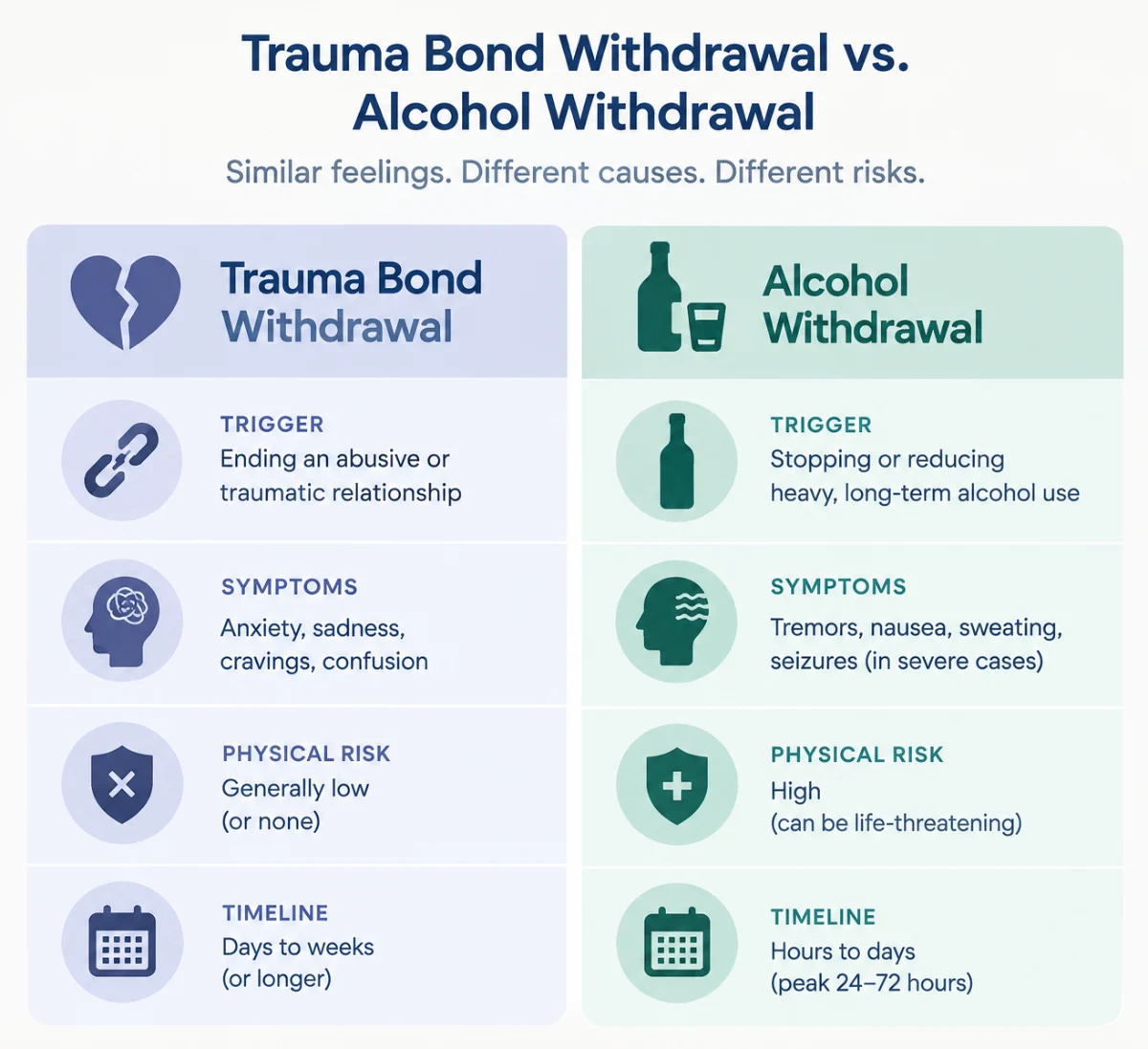
Both conditions can involve anxiety and a strong urge to reconnect with what was lost. They should not be confused with each other. Alcohol withdrawal, especially after heavy or prolonged use, should be treated by a medical provider as soon as possible, without delay.
Treating Trauma and Alcohol Abuse Together
If trauma and alcohol use are connected for a given person, treating only the drinking can leave the underlying trigger unaddressed. Treating trauma while ignoring active alcohol use can leave an equally important part of the cycle untreated. The VA notes that PTSD and substance use can be treated concurrently, including through integrated approaches that address both conditions in the same course of care.
Trauma Treatment
These trauma-focused therapies have strong clinical evidence behind them:
- Cognitive Processing Therapy (CPT) helps patients identify and reframe distorted beliefs formed by the trauma, such as excessive self-blame.
- Prolonged Exposure (PE) reduces the power of trauma triggers through gradual, guided exposure in a controlled setting.
- EMDR helps the brain reprocess traumatic memories using structured eye-movement techniques, reducing their emotional intensity over time.
Alcohol Use Disorder Treatment
Not every patient needs every option below. Alcohol treatment gets matched to severity and personal history. It typically includes:
- Behavioral therapy and motivational approaches to build readiness for change
- Relapse prevention planning built around each person’s specific triggers
- Mutual-support options, such as 12-step programs or peer recovery groups
- Medications to reduce cravings, when clinically appropriate
- Medical management of withdrawal, especially after heavy or long-term use
What Is Inpatient Trauma Treatment?
Inpatient trauma treatment means living at a treatment facility full-time. Patients receive structured therapy, medical support, and around-the-clock supervision, instead of attending sessions and returning home each day.
It tends to help people with severe trauma symptoms, a co-occurring alcohol use disorder, or an unsafe and unstable home environment. It also helps people with a pattern of repeated relapse or major disruption to daily functioning. It is not necessary for everyone. Outpatient care works well for many people, especially those with milder symptoms or strong support systems at home.
Integrated inpatient care generally follows a clear sequence. It starts with assessment and stabilization. From there, it moves into substance-use treatment and trauma-informed therapy, with psychiatric care added when appropriate. The final stages focus on coping skills, relapse-prevention planning, and continuing care after discharge.
What Does Trauma-Informed Alcohol Treatment Look Like?
Trauma-informed treatment follows a framework, not one single technique. SAMHSA’s guidance defines six principles: safety, trustworthiness and transparency, peer support, collaboration and mutuality, empowerment and choice, and attention to cultural and historical context.
In an alcohol treatment setting, this framework shows up in specific ways:
- Screening for trauma history at intake, not just substance use history
- Avoiding treatment approaches that recreate a sense of powerlessness or lack of control
- Giving patients real choices and clear information at every stage of care
- Pacing trauma-focused work carefully, so it does not overwhelm an already dysregulated nervous system
- Training staff to recognize trauma responses, like dissociation or shutdown, instead of mistaking them for resistance to treatment
Breaking the Cycle of Trauma and Alcohol Abuse
Recovery is not about blaming someone for how they coped with an overwhelming experience. It is about replacing a coping strategy that has become harmful with ones that are safer and more sustainable long-term.
That progression generally follows these steps: recognize the trauma-alcohol connection, assess both trauma history and current drinking, and stabilize any immediate alcohol-related risk. From there, the focus shifts to developing alternative coping strategies, treating trauma symptoms directly, and treating the AUD itself. The final steps involve identifying personal triggers and building both a relapse-prevention plan and an ongoing support system.
When to Seek Professional Help
An assessment is worth pursuing when drinking is difficult to control, when alcohol is being used specifically to manage trauma symptoms, or when either one is interfering with daily life, relationships, or work.
Additional signs it’s time to reach out:
- Experiencing withdrawal symptoms like, shaking, sweating, or nausea even when not drinking
- Repeated, unsuccessful attempts to cut back or stop
- Trauma symptoms and drinking patterns appearing to feed each other
A safety note: Abruptly stopping heavy or prolonged alcohol use can be medically dangerous, including risk of seizures. Anyone in that situation should talk to a medical provider about a supervised approach rather than stopping alone.
Final Thoughts
If you recognized yourself in even a few of these patterns, that recognition is the hard part, and it’s already behind you.
At Legacy Healing Ohio, we treat trauma and alcohol use together, not as two separate problems handed to two separate teams. Our clinical team screens for trauma history at intake, and we build the treatment plan around both conditions from day one, whether that means outpatient care, a higher level of support, or a full inpatient program.
You don’t have to have this figured out before you call. If you want to talk through what treatment could look like for your situation, our admissions team is available at 5135864971 anytime, and every conversation stays confidential.