



-
 Written By:
Kristina Daniels
-
Edited By:
Phyllis Rodriguez, PMHNP-BC
-
Clinically Reviewed By:
Dr. Ash Bhatt, MD, MRO
 Written By:
 Edited By:
 Clinically Reviewed By:
Key Takeaways
- Group therapy has eight main types, each with a different purpose, such as education, coping skills, or relationship work. The purpose tells you what to expect.
- Programs combine several group types and choose them based on stage of recovery, mental health symptoms, and trauma history.
- Peer-led support groups such as 12-Step meetings complement therapy groups, and they do not replace clinician-led treatment.
Group therapy in addiction treatment is a structured session led by a trained clinician, in which people in recovery work on treatment goals together. It is not a single method, because programs use several types of groups, each with its own purpose.
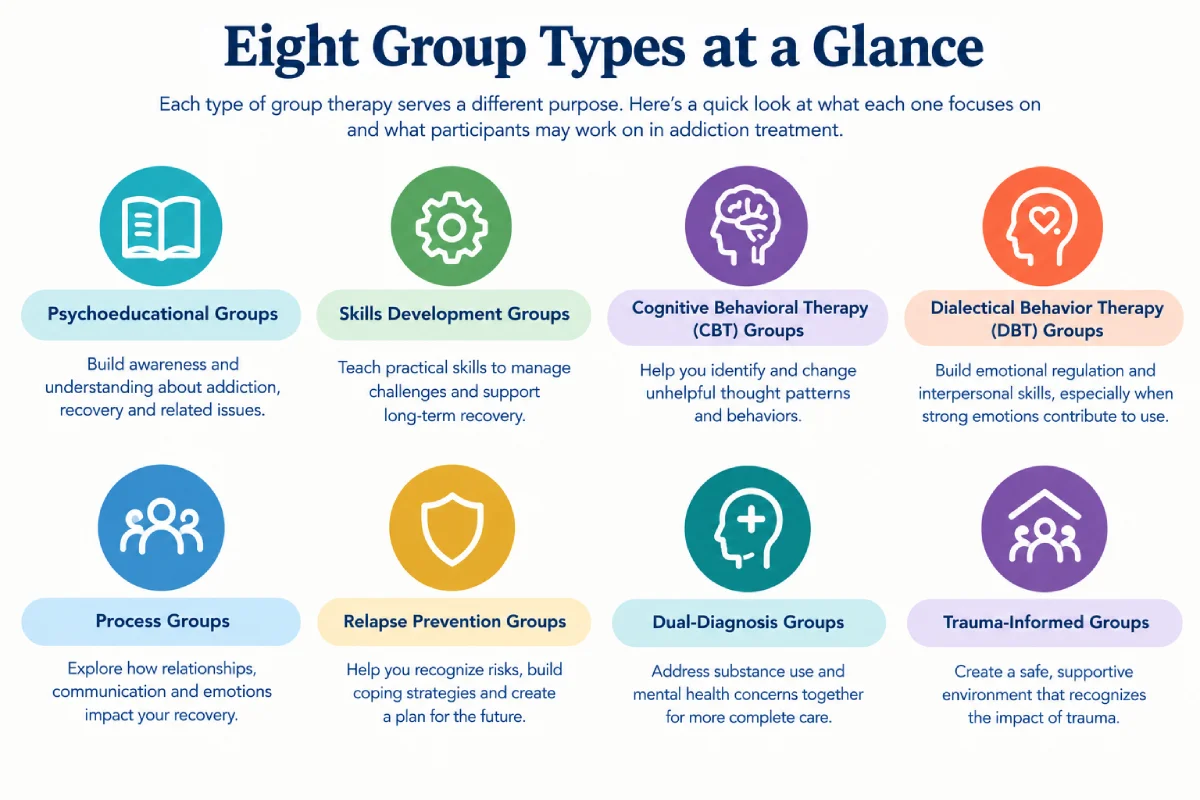
This article explains the types of group therapy used in treatment, which are psychoeducation, coping-skills groups, CBT, DBT, process groups, relapse prevention, dual-diagnosis groups, and trauma-informed care. It also covers how clinicians choose among them and what a session involves.
What Is Group Therapy in Addiction Treatment?
Group therapy differs from an informal support meeting because a trained leader runs it and because it has defined recovery goals. SAMHSA’s Treatment Improvement Protocol 41 (TIP 41) limits its guidance to groups that have trained leaders and aim to produce healing or recovery from substance use. The leader sets the focus, keeps the discussion safe, and returns it to recovery when it drifts.
Group therapy is also one of the most widely available treatments. SAMHSA’s National Survey of Substance Abuse Treatment Services found that more than 90 percent of U.S. treatment facilities offered group therapy in 2019.
Programs run groups alongside individual therapy because the two do different work. In fact, group therapy can be as effective as individual therapy and, in some cases, even more beneficial. Depending on the group, a session may provide:
- Education: facts about addiction and recovery.
- Skills Practice: rehearsal of responses to cravings and triggers.
- Interpersonal Work: examination of how members relate to other people.
- Peer Support: contact with others who understand the struggle.
The Main Types of Group Therapy Used in Addiction Treatment
Addiction affects what a person knows, how a person copes, how a person thinks, and how a person relates to others. No single group addresses all four, so programs use different group types, each aimed at one of these needs. The table below summarizes the types, and the subsections that follow explain what each one involves.
1. Psychoeducational Groups
Psychoeducation means teaching people about addiction and recovery so they can make informed decisions during treatment. Psychoeducational groups are one of five models that teach about substance use. A session typically covers:
- How substances affect the brain and body.
- What triggers and cravings are, and why they occur.
- What treatment involves and what recovery can look like.
Many people begin treatment with gaps in what they know about their own addiction. A person who understands why cravings peak is less likely to read a craving as evidence that treatment is failing, which can help that person keep attending.
2. Skills Development and Coping-Skills Groups
Coping-skills groups focus on practicing the abilities needed to stop using and to stay stopped. Typical topics include:
- Coping with cravings and avoiding triggers.
- Managing stress and anger.
- Communication and refusal skills.
- Problem-solving and relaxation techniques.
Psychoeducation provides information, and a coping-skills group has members rehearse what to do with it. In a refusal-skills session, for example, members role-play declining a drink from a coworker until the response comes out steadily.
3. Cognitive Behavioral Therapy (CBT) Groups
CBT groups apply cognitive behavioral therapy to substance use in a group setting. The central idea is that thoughts, feelings, and behaviors influence one another, so changing a thinking pattern can change what a person does next. Cognitive-behavioral groups are groups that rearrange patterns of thinking and action that lead to addiction.
Members identify the thoughts that come before use, recognize conditioned triggers such as places or times of day, and plan a different response. Hearing another member describe the same thought makes it easier to recognize one’s own.
Clinical Insight From Dr. Ash Bhatt
Thoughts that lead to relapse usually sound reasonable. Examples are “I have earned this” and “one drink won’t matter after today.” In group, I ask members to say these thoughts aloud, because other members recognize them quickly. I also ask each member to write down one such thought before leaving a session and to bring it to the next.
4. Dialectical Behavior Therapy (DBT) Groups
DBT groups are included because strong, hard-to-manage emotions drive substance use for many patients. DBT was developed to treat intense emotional swings, and clinicians have adapted it for people who use substances to escape or numb those emotions. A DBT skills group teaches four areas:
- Mindfulness: Staying with the present moment instead of reacting to it.
- Distress Tolerance: Getting through a crisis without using.
- Emotion Regulation: Understanding emotions and lowering their intensity.
- Interpersonal Effectiveness: Asking for what one needs and setting limits.
A DBT skills group is one component of comprehensive DBT, which also includes individual therapy, between-session coaching, and a clinician consultation team. Attending the group provides the skills training and does not amount to full DBT, so patients should confirm which version a program offers.
5. Process Groups
Process groups are included because many people with addiction also struggle in relationships, and the group itself becomes the place where those struggles appear and can be worked on. Interpersonal process groups are very important, as they help clients work through problems in relating to other people, problems that many have tried to escape through substances. Members examine:
- How they react when another member disagrees with them.
- Whether they tend to withdraw, argue, or try to please.
- How trust builds or breaks down.
- What the group observes about how they come across.
Skills groups teach what to do, while process groups examine what happens between a person and other people and how those patterns affect recovery. These groups are less widely used because leaders need extensive training and the groups run for a long time, so not every program offers them.
6. Relapse Prevention Groups
If you’ve returned to use after a period of recovery, you may be wondering what could be different this time. Relapse prevention groups are built to help you answer that question. A return to use isn’t proof that treatment can’t work for you. According to the National Institute on Drug Abuse, relapse rates for addiction are similar to those for other chronic conditions like hypertension and asthma, where a setback means the plan needs adjusting, not that the person has failed.
In these groups, you’ll look back at past relapses without shame, identify the early warning signs that showed up before you used (like isolating, skipping support, or thinking “I’ve got this handled”), and map out the situations most likely to test you, such as a family conflict, a holiday, or a job loss. From there, you’ll build a written coping plan and practice it through role-play, including what to do if a slip happens so one lapse doesn’t turn into a full return to use. Being surrounded by others who have been there also eases the feeling that you’re the only one who keeps struggling.
These groups apply other models and do not form a separate method. SAMHSA’s group framework treats relapse prevention as a specialized approach that can draw on CBT, psychoeducation, skills development, support, and process techniques. If recovery didn’t hold before, that experience isn’t wasted. It’s information you can use to build a plan that fits your life.
7. Dual-Diagnosis Groups for Co-Occurring Disorders
Dual-diagnosis groups treat substance use and mental health conditions within the same program. Anxiety, depression, and trauma-related symptoms often exist alongside substance use, and each can trigger cravings.
SAMHSA’s 2024 National Survey on Drug Use and Health estimated that 21.2 million U.S. adults had both a mental illness and a substance use disorder, and 41.2 percent of them received no treatment for either.
Treating only the substance use leaves the symptoms in place that feed it. Dual-diagnosis groups combine skills building with peer support, so a member can practice managing panic symptoms without turning to alcohol. This approach is the group-based counterpart of dual diagnosis treatment.
8. Trauma-Informed Group Therapy
Trauma-informed care describes how a group is run, and it can apply to any format above. It does not name a separate type of group. A trauma-informed group typically includes:
- A predictable structure that supports safety.
- Choice about what to share and when.
- Respect for personal boundaries.
- Screening and clinical support before trauma-focused work begins.
Trauma-focused groups, in which members directly work through traumatic memories, require a facilitator trained for that work. Poorly paced discussion can distress members and set recovery back.
Clinical Insight From Dr. Ash Bhatt
Regarding participant choice, you decide how much you share, and listening counts as participation. If a topic becomes too much, I tell members they may step out for a few minutes and return. If a program expects your full trauma history in the first week, ask about its screening process and the clinical support available.
9. Support Groups vs. Therapy Groups
A professionally led therapy group is guided by a trained clinician, has clear treatment goals, and fits into the patient’s overall clinical plan. A peer-led support group, like a 12-Step meeting, is run by members who have been through recovery themselves, so it doesn’t offer clinical treatment.
12-Step programs aren’t group therapy, but they work alongside it as complementary parts of the recovery process. Peer support can help a person stay sober, while therapy groups dig into the emotional and relationship issues that often fuel substance use. That’s why many programs encourage patients to use both.
How Group Therapy Types Work Together in Addiction Treatment
A single group often blends models, so one session may teach a skill while members also support one another. One illustrative path, which is not a universal sequence, is the following:
- Psychoeducation builds a shared understanding of addiction.
- Skills groups turn that understanding into practice.
- CBT works on the thinking patterns behind use.
- Process groups examine relationship patterns.
- Relapse prevention combines the work into a plan for life after treatment.
Programs adjust the mix as a patient’s needs change, and some patients attend several formats in the same week.
How Clinicians Decide Which Group Fits You
Placement follows an assessment of what each patient needs at that point in treatment. Therapists consider the following factors:
- Stage of Recovery: early treatment often relies on education and skills groups, while process work tends to suit patients who have stabilized.
- Mental Health Symptoms: these may indicate a dual-diagnosis group.
- Trauma History: this determines how carefully screening and pacing are handled.
- Relapse Risk and Emotional Regulation: these may indicate relapse prevention or DBT skills groups.
- Readiness: a patient in acute withdrawal may need to stabilize before joining a group.
No single group is better for every patient. Our clinical team makes this match after assessment and revisits it as needs change.
What to Expect During Group Therapy in Rehab
Details differ by program, but most groups share these features:
- Size and Frequency: both vary by program and by level of care.
- Structure: a typical session includes a check-in, a topic or skill practice, discussion, and a closing round.
- Facilitator Role: the therapist guides the topic, keeps the discussion respectful, and steps in if a member is struggling.
- Participation: it is expected over time, although many facilitators allow new members to listen first.
- Confidentiality: members are asked to keep what is shared private, but other members cannot be legally bound to do so, and therapists must report certain situations, such as risk of serious harm.
- Group Rules: common rules include arriving on time and not speaking over others.
- Open vs. Closed Groups: open groups accept new members at any time, and closed groups keep the same members from start to finish.
Individual therapy usually runs alongside group sessions and gives patients a private setting to discuss anything they prefer not to raise in group.
Group Therapy vs. Individual Therapy for Addiction
| Group Therapy | Individual Therapy |
| Peer interaction and shared experience | One-on-one attention |
| Practice with other people | Private exploration |
| Feedback from several members | Feedback from the therapist |
| Social connection | Greater privacy |
The two formats complement each other. Individual therapy usually runs alongside group sessions and gives patients a private setting to discuss anything they prefer not to raise in group.
Group Therapy at Legacy Healing Ohio: Final Thoughts
Group therapy works best when each group has a clear purpose and the mix of groups matches the patient. At Legacy Healing Ohio, group therapy is part of a broader treatment plan, and our clinical team assigns groups after an assessment of each patient’s stage of recovery, mental health symptoms, and trauma history. Our group programming includes:
- Psychoeducational and Coping-Skills Groups: these teach patients how addiction works and give them a place to practice responses to cravings and triggers.
- CBT and DBT Skills Groups: these target the thoughts and emotional swings that lead to substance use.
- Process and Relapse Prevention Groups: these address relationship patterns and build a written plan for high-risk situations.
- Dual-Diagnosis Groups: these treat substance use and co-occurring mental health symptoms in the same program.
We review each patient’s group schedule as treatment progresses and adjust it when needs change. If you are comparing programs, contact our admissions team to ask which groups fit your situation and how they work alongside individual therapy.